Femicore Official Website › The label
Femicore Supplement Facts: The Label Transcribed
The Femicore panel gives one capsule as the serving and 30 servings per container.
It lists a 350 mg Herbal Blend of four botanicals and a 50 mg Probiotic Blend of five Lactobacillus strains.
Learn what each name is for on Femicore ingredients.
This page publishes the label photograph at full size so you can check every sentence on this website against it.
The whole Femicore label, front and back
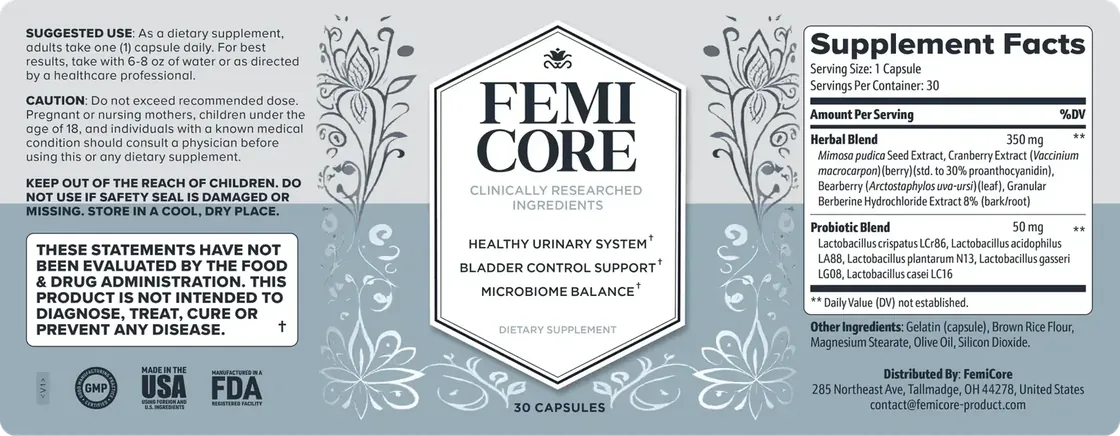
This is the manufacturer’s own label artwork, shipped in the product asset pack and reproduced here at the size it was supplied. Everything this website states about the formula is read off it.
Four blocks are worth finding on it. On the left, the suggested use and the caution paragraph. Below those, the FDA statement in a ruled box. In the centre, the hexagon carrying the three claim lines and the capsule count. On the right, the Supplement Facts panel, the Other Ingredients line and the distributor address.
At the bottom left sit three marks: GMP certified, Made in the USA, and manufactured in an FDA-registered facility. The third of those is the one most often misread, and it is explained on the testing and quality page.
The Femicore Supplement Facts panel, transcribed
| Line | As printed | Reading note |
|---|---|---|
| Serving Size | 1 Capsule | One capsule is the whole serving. There is no two-capsule option on this label. |
| Servings Per Container | 30 | Thirty days at the stated serving. |
| Herbal Blend | 350 mg | A proprietary blend total. A ceiling, not a distribution. |
| Mimosa pudica Seed Extract | First, so the largest of the four by weight. | |
| Cranberry Extract (Vaccinium macrocarpon) (berry) (std. to 30% proanthocyanidin) | The only standardisation figure on the whole panel. | |
| Bearberry (Arctostaphylos uva-ursi) (leaf) | The leaf, which is the part traditionally used. | |
| Granular Berberine Hydrochloride Extract 8% (bark/root) | 8% berberine by weight of the extract, so the berberine itself is a fraction of a fraction. | |
| Probiotic Blend | 50 mg | A second proprietary total. No colony count. |
| Lactobacillus crispatus LCr86 | First, so the largest of the five. | |
| Lactobacillus acidophilus LA88 | ||
| Lactobacillus plantarum N13 | Absent from some seller summaries. | |
| Lactobacillus gasseri LG08 | Absent from some seller summaries. | |
| Lactobacillus casei LC16 | Last, so the smallest of the five. | |
| Daily Value | Not established | Normal on a botanical panel, and not a warning. |
| Other Ingredients | Gelatin (capsule), Brown Rice Flour, Magnesium Stearate, Olive Oil, Silicon Dioxide | Gelatin means the capsule is not vegetarian. |
Nine figures the Femicore label does not print
- ✓The amount of mimosa pudica seed extract per capsule
- ✓The amount of cranberry extract, and therefore the milligrams of proanthocyanidin
- ✓The amount of bearberry leaf, and any limit on how long to take it
- ✓The amount of berberine extract, before the 8% is applied
- ✓The colony forming unit count of the probiotic blend
- ✓The colony forming unit count of any individual strain
- ✓The split of the 50 mg between the five strains
- ✓An allergen statement, so milk, soy and gluten status cannot be confirmed
- ✓A best-before date in the artwork, which is stamped on the physical bottle
Every one of those is a number that exists somewhere inside the manufacturing record. None of them is on the bottle, and this desk does not have them either. If they are published, this page will carry them and the review date at the foot will move forward.
How to read a panel like the Femicore one in five minutes
Find the serving size first
Everything else on the panel is per serving. A product with a three-capsule serving and a 90-count bottle is a 30-day supply, not a 90-day one. Here the serving is one capsule and the bottle is 30, which is the simplest case.
Add up the declared weight
350 mg plus 50 mg is 400 mg of named material. A capsule of this size holds considerably more than that, and the difference is the shell and the excipients in the Other Ingredients line. That is normal and not a criticism.
Check for a standardisation figure
Standardised to 30% proanthocyanidin is the single most informative phrase on this panel. It tells you the cranberry extract is measured against the compound the research is about, rather than sold by dried weight.
Read the order of names
Descending by weight is required. That is how you know mimosa pudica is the largest botanical and casei LC16 is the smallest strain, without a single milligram being printed.
Look for the unit that matches the ingredient
Botanicals are dosed in milligrams and live organisms are dosed in colony forming units. A probiotic blend declared only in milligrams is missing its own unit of measurement, and that is the gap on this label that matters most.
What the first name on the Femicore panel tells you, and what it does not
Labelling rules require the ingredients inside a proprietary blend to be listed in descending order by weight. That single rule is the only distribution information a blend gives up, and it is worth using.
On this panel it means mimosa pudica seed extract is the largest botanical in the 350 mg blend, ahead of cranberry, which is ahead of bearberry, which is ahead of the berberine extract. It also means crispatus LCr86 is the largest of the five strains in the 50 mg blend and casei LC16 is the smallest.
What it does not tell you is by how much. First place is compatible with 340 mg out of 350 and it is equally compatible with 95 mg out of 350. Descending order is an ordering, not a distribution, and treating it as one is the commonest mistake made when reading a blend.
There is a mild irony worth noting in the order here. The largest botanical on this panel is the one with the least published human evidence behind it, and the one carrying the standardisation figure and the Cochrane review sits second. That is not an accusation of anything, because weight and evidence are unrelated quantities. It is simply the first thing a careful reader notices about this label, and a page that left it out would not be worth much.
How the Femicore label page is kept accurate
This desk publishes what the bottle says and marks the gaps. The four claims below are the ones a sceptical reader can audit in ten minutes, which is the only reason worth making them:
- The printed panel is the source. The three claim lines, the two blend totals, the nine names, the capsule count and the serving instruction are read off the FemiCore label photograph in our own asset folder, not from a review column and not from a summary.
- Not published stays not published. This panel prints 350 mg for the herbal blend and 50 mg for the probiotic blend and no amount for any of the nine names inside them. It prints no colony count for any strain. Nothing undisclosed is estimated anywhere on this website, including in the structured data a machine reads.
- Sources are real and linked in the sentence. Every study cited here was confirmed against its PubMed record through the NCBI programming interface before it was written down, and every government page was checked against its own site root first, because two of these hosts refuse a non-browser client in a way that looks exactly like a dead link.
- Corrections change the date. Write to [email protected] and the review date at the foot of the page moves forward with the fix.
We earn when you buy. Femicoredaily is the Femicore retail desk named at the top of this page, and this website makes money on orders placed through it. That is exactly why the missing-amounts table, the bearberry duration limit, the berberine interaction list and the page recommending the three-bottle pack over the six are here. They are where our interest and yours pull apart, and you should be able to watch us choose.
The desk on +1 (302) 200-3480 handles tracking, address changes and refunds, which is real service and worth having. It is not a sales line, and this website never presents it as a way to place an order. Orders go through the checkout only.

Every page, every journal post, the bottle facts and the ingredients go through review by Dr. Susan Vogler, DO, FACOG, MSCP before they ship. We write these pages from the printed FemiCore Supplement Facts panel and the manufacturer’s own sales page, cite public research for each named botanical and each named strain, and print “not published” wherever a figure is not disclosed rather than estimating it. This panel publishes two blend totals and no amount for any of the nine names inside them, and no colony count for any strain, and that fact appears on every page where an ingredient is named. Where the seller’s marketing claims more than the label supports, we say so on the page. The Physician Formulated roundel beside this paragraph names no clinician and publishes no credential, and we treat it as a manufacturer’s statement about its own process rather than as a review. Corrections are made on the page itself and the review date moves forward. Write to [email protected]. Last reviewed September 2026 by Dr. Susan Vogler, DO, FACOG, MSCP.
Sources behind the Femicore label page
- National Center for Complementary and Integrative Health. Probiotics: What You Need To Know. https://www.nccih.nih.gov/health/probiotics-what-you-need-to-know
- Babar A, Moore L, Leblanc V, et al. High dose versus low dose standardized cranberry proanthocyanidin extract for the prevention of recurrent urinary tract infection in healthy women: a double-blind randomized controlled trial. BMC Urol. 2021;21(1):44. https://pubmed.ncbi.nlm.nih.gov/33757474/
- National Institute of Diabetes and Digestive and Kidney Diseases. Bladder Control Problems (Urinary Incontinence). https://www.niddk.nih.gov/health-information/urologic-diseases/bladder-control-problems
Femicore label questions
What does the Femicore Supplement Facts panel say?
Serving size one capsule, 30 servings per container, a Herbal Blend at 350 mg holding four botanicals, a Probiotic Blend at 50 mg holding five Lactobacillus strains, and a line stating that the Daily Value is not established for either.
Does the Femicore label publish milligrams per ingredient?
No. Both lists are proprietary blends, so only the two group totals appear.
How many capsules are in a bottle of Femicore?
Thirty, which the panel states as servings per container and the front of the bottle repeats as 30 capsules. At one capsule a day that is a 30-day supply.
What does Daily Value not established mean on the Femicore panel?
It means no regulator has set a reference intake for these substances, so there is no percentage to print. It is a normal entry on a botanical panel and it is not a warning.
Order Femicore knowing exactly what the panel says
Two blend totals, nine names, and the nine figures the label leaves out, printed here so you can check the bottle against this page.
From $49 a bottle · 60 days to change your mind
Order Femicore On The Official WebsiteOne-time payment, no subscription · 60-day money-back guarantee · lot FEM-26/FE-3921 · tracking and refunds on +1 (302) 200-3480