Femicore Official Website › How it works
How Does Femicore Work? The Three Routes Behind the Capsule
Femicore is meant to work through three routes in one daily capsule.
Cranberry proanthocyanidins may interfere with bacterial adhesion, five Lactobacillus strains may support the urogenital microbiota, and bearberry and berberine may add antimicrobial activity.
For the printed blend totals, read the Femicore label.
This page gives each route the strongest case that can honestly be made for it, and then says exactly where that case runs out.
The adhesion route in Femicore: cranberry proanthocyanidin
The oldest idea in this category, and the best supported one. Certain bacteria attach to the lining of the urinary tract using surface structures called fimbriae. Cranberry proanthocyanidins appear to interfere with that attachment, which is a different mechanism from killing the organism: something that cannot hold on is washed out.
The 2023 Cochrane review is the document to read. It pooled the randomised evidence and found cranberry products reduced repeat symptomatic infection in women with recurrent infection, in children, and in people undergoing an intervention on the bladder. It also found no benefit in several other populations, including older adults in institutional care and people with bladder emptying problems. That is a specific finding in specific groups, not a general urinary tonic.
The companion review of cranberry as a treatment is the one a seller will not quote. For an infection already present, the evidence does not support cranberry. Prevention and treatment are different questions and cranberry answers only one of them.
The dose question is live rather than settled. A randomised trial in 2021 compared 2 mg of proanthocyanidin a day against 37 mg in healthy women with recurrent infection, which tells you researchers themselves do not regard the amount as obvious. FemiCore prints a standardisation figure of 30% proanthocyanidin and no amount of cranberry extract, so the milligrams of proanthocyanidin in a capsule cannot be calculated from the label.
The colonisation route in Femicore: five Lactobacillus strains
A healthy vaginal microbiota in most women is dominated by lactobacilli, very often L. crispatus, and that dominance is associated with a low pH and fewer of the organisms that cause trouble (Chee and colleagues, 2020). The proposal behind a probiotic like this one is that swallowed organisms survive the stomach, pass through the gut and reach the urogenital tract in enough numbers to shift that balance.
The evidence splits into two halves that are easy to confuse. The half that is strong concerns L. crispatus itself. A strain called CTV-05 completed a phase 1 trial and then a randomised, placebo-controlled phase 2 trial in women with recurrent urinary tract infection, and a later formulation of the same organism was tested against bacterial vaginosis recurrence and published in the New England Journal of Medicine in 2020. That is a serious research record for a probiotic strain.
The half that is weak concerns the route. Every one of those trials put the organism where it was meant to live, as an intravaginal suppository or applicator. Femicore is swallowed. Oral transfer is not impossible and has been demonstrated: Reid and colleagues in 2003 altered vaginal flora with two oral strains, and a 2024 randomised trial in pregnancy tested an oral probiotic against vulvovaginal infection. Neither studied LCr86, and neither used a count this label discloses.
That is the honest description of route two: a genuinely well-studied organism, in a dose form its trials did not use, at a viable count nobody has published. NCCIH puts the general version of this warning plainly -- probiotic effects are strain-specific and dose-specific, so neither can be assumed.
The antimicrobial route in Femicore: bearberry and berberine
Bearberry leaf carries arbutin, which the body converts and excretes in the urine as hydroquinone conjugates. The traditional reasoning is sound in outline: a compound concentrated in the urine acts where the problem is. It has been tested against an antibiotic in a randomised trial in primary care, and the herb did not prove a satisfactory substitute for fosfomycin in uncomplicated infection. That is a useful result in both directions: it is real research on a real extract, and it did not support replacing the antibiotic.
Berberine has striking laboratory activity against a wide range of organisms and a well-documented problem: very little of a swallowed dose reaches the bloodstream. Liu and colleagues in 2016 reviewed the work done to improve that, which is an entire research field in itself. An umbrella review in 2023 found the human evidence strongest in metabolic outcomes rather than urinary ones.
On this label, berberine arrives as an 8% extract, which is the phrase to read twice. Eight per cent means the berberine content is eight parts in a hundred of the extract weight, and the extract weight is inside a 350 mg blend that is not broken down. Whatever the trials used, this is not that.
Route three is therefore the one with the clearest mechanism and the widest gap between the mechanism and the capsule. Both ingredients do something. Neither is here in an amount anyone outside the factory can name.
What Femicore cannot do, mechanically
Nothing on this panel relaxes the detrusor muscle, which is what an overactive bladder medication does. Nothing on it strengthens the pelvic floor, which is what the first-line treatment for stress incontinence does and which has a Cochrane review behind it. Nothing on it is an antibiotic, and an infection needs one (the AUA, CUA and SUFU guideline sets out how recurrent infection is actually managed).
That matters because the three printed claims include bladder control support, and a reader can be forgiven for reading that as an effect on leakage. There is no ingredient on this panel with a trial showing an effect on urgency, frequency or leakage. If bladder control is your reason for being on this page, the honest advice is to read the NIDDK page on bladder control problems first and to treat this capsule as something you might add to a plan rather than as the plan.
How this Femicore mechanism page was written
This desk publishes what the bottle says and marks the gaps. The four claims below are the ones a sceptical reader can audit in ten minutes, which is the only reason worth making them:
- The printed panel is the source. The three claim lines, the two blend totals, the nine names, the capsule count and the serving instruction are read off the FemiCore label photograph in our own asset folder, not from a review column and not from a summary.
- Not published stays not published. This panel prints 350 mg for the herbal blend and 50 mg for the probiotic blend and no amount for any of the nine names inside them. It prints no colony count for any strain. Nothing undisclosed is estimated anywhere on this website, including in the structured data a machine reads.
- Sources are real and linked in the sentence. Every study cited here was confirmed against its PubMed record through the NCBI programming interface before it was written down, and every government page was checked against its own site root first, because two of these hosts refuse a non-browser client in a way that looks exactly like a dead link.
- Corrections change the date. Write to [email protected] and the review date at the foot of the page moves forward with the fix.
We earn when you buy. Femicoredaily is the Femicore retail desk named at the top of this page, and this website makes money on orders placed through it. That is exactly why the missing-amounts table, the bearberry duration limit, the berberine interaction list and the page recommending the three-bottle pack over the six are here. They are where our interest and yours pull apart, and you should be able to watch us choose.
The desk on +1 (302) 200-3480 handles tracking, address changes and refunds, which is real service and worth having. It is not a sales line, and this website never presents it as a way to place an order. Orders go through the checkout only.

Every page, every journal post, the bottle facts and the ingredients go through review by Dr. Susan Vogler, DO, FACOG, MSCP before they ship. We write these pages from the printed FemiCore Supplement Facts panel and the manufacturer’s own sales page, cite public research for each named botanical and each named strain, and print “not published” wherever a figure is not disclosed rather than estimating it. This panel publishes two blend totals and no amount for any of the nine names inside them, and no colony count for any strain, and that fact appears on every page where an ingredient is named. Where the seller’s marketing claims more than the label supports, we say so on the page. The Physician Formulated roundel beside this paragraph names no clinician and publishes no credential, and we treat it as a manufacturer’s statement about its own process rather than as a review. Corrections are made on the page itself and the review date moves forward. Write to [email protected]. Last reviewed September 2026 by Dr. Susan Vogler, DO, FACOG, MSCP.
Sources behind the Femicore mechanism page
- Williams G, Hahn D, Stephens JH, Craig JC, Hodson EM. Cranberries for preventing urinary tract infections. Cochrane Database Syst Rev. 2023;4(4):CD001321. https://pubmed.ncbi.nlm.nih.gov/37068952/
- Jepson RG, Mihaljevic L, Craig JC. Cranberries for treating urinary tract infections. Cochrane Database Syst Rev. 2023;12(12):CD001322. https://pubmed.ncbi.nlm.nih.gov/38096261/
- Babar A, Moore L, Leblanc V, et al. High dose versus low dose standardized cranberry proanthocyanidin extract for the prevention of recurrent urinary tract infection in healthy women: a double-blind randomized controlled trial. BMC Urol. 2021;21(1):44. https://pubmed.ncbi.nlm.nih.gov/33757474/
- Stapleton AE, Au-Yeung M, Hooton TM, et al. Randomized, placebo-controlled phase 2 trial of a Lactobacillus crispatus probiotic given intravaginally for prevention of recurrent urinary tract infection. Clin Infect Dis. 2011;52(10):1212-7. https://pubmed.ncbi.nlm.nih.gov/21498386/
- Czaja CA, Stapleton AE, Yarova-Yarovaya Y, Stamm WE. Phase I trial of a Lactobacillus crispatus vaginal suppository for prevention of recurrent urinary tract infection in women. Infect Dis Obstet Gynecol. 2007;2007:35387. https://pubmed.ncbi.nlm.nih.gov/18288237/
- Cohen CR, Wierzbicki MR, French AL, et al. Randomized trial of Lactin-V to prevent recurrence of bacterial vaginosis. N Engl J Med. 2020;382(20):1906-1915. https://pubmed.ncbi.nlm.nih.gov/32402161/
- Chee WJY, Chew SY, Than LTL. Vaginal microbiota and the potential of Lactobacillus derivatives in maintaining vaginal health. Microb Cell Fact. 2020;19(1):203. https://pubmed.ncbi.nlm.nih.gov/33160356/
- Reid G, Charbonneau D, Erb J, et al. Oral use of Lactobacillus rhamnosus GR-1 and L. fermentum RC-14 significantly alters vaginal flora: randomized, placebo-controlled trial in 64 healthy women. FEMS Immunol Med Microbiol. 2003;35(2):131-4. https://pubmed.ncbi.nlm.nih.gov/12628548/
- Yefet E, Colodner R, Strauss M, Gam Ze Letova Y, Nachum Z. Efficacy of oral probiotic supplementation in preventing vulvovaginal infections during pregnancy: a randomized and placebo-controlled clinical trial. Nutrients. 2024;17(1):2. https://pubmed.ncbi.nlm.nih.gov/39771026/
- National Center for Complementary and Integrative Health. Probiotics: What You Need To Know. https://www.nccih.nih.gov/health/probiotics-what-you-need-to-know
- Gágyor I, Hummers E, Schmiemann G, et al. Herbal treatment with uva ursi extract versus fosfomycin in women with uncomplicated urinary tract infection in primary care: a randomized controlled trial. Clin Microbiol Infect. 2021;27(10):1441-1447. https://pubmed.ncbi.nlm.nih.gov/34111592/
- Schindler G, Patzak U, Brinkhaus B, et al. Urinary excretion and metabolism of arbutin after oral administration of Arctostaphylos uvae ursi extract as film-coated tablets and aqueous solution in healthy humans. J Clin Pharmacol. 2002;42(8):920-7. https://pubmed.ncbi.nlm.nih.gov/12162475/
- Liu CS, Zheng YR, Zhang YF, Long XY. Research progress on berberine with a special focus on its oral bioavailability. Fitoterapia. 2016;109:274-82. https://pubmed.ncbi.nlm.nih.gov/26851175/
- Li Z, Wang Y, Xu Q, et al. Berberine and health outcomes: an umbrella review. Phytother Res. 2023;37(5):2051-2066. https://pubmed.ncbi.nlm.nih.gov/36999891/
- Dumoulin C, Cacciari LP, Hay-Smith EJC. Pelvic floor muscle training versus no treatment, or inactive control treatments, for urinary incontinence in women. Cochrane Database Syst Rev. 2018;10(10):CD005654. https://pubmed.ncbi.nlm.nih.gov/30288727/
- Anger J, Lee U, Ackerman AL, et al. Recurrent uncomplicated urinary tract infections in women: AUA/CUA/SUFU guideline. J Urol. 2019;202(2):282-289. https://pubmed.ncbi.nlm.nih.gov/31042112/
- National Institute of Diabetes and Digestive and Kidney Diseases. Bladder Control Problems (Urinary Incontinence). https://www.niddk.nih.gov/health-information/urologic-diseases/bladder-control-problems
Femicore mechanism questions
How does Femicore work?
Three proposed routes. Cranberry proanthocyanidins may interfere with bacterial adhesion in the urinary tract; the five Lactobacillus strains are intended to support the balance of the urogenital microbiota; and bearberry and berberine bring antimicrobial activity. Each has research behind the ingredient and none has research behind this capsule.
Has Femicore itself been tested in a trial?
No. There is no clinical trial of the finished capsule. Every study cited on this website concerns one ingredient or one strain, usually at a stated dose this label does not disclose.
Why does Femicore contain both herbs and probiotics?
The two halves address different ideas. The botanicals are about making the urinary tract a less hospitable place for unwanted organisms; the strains are about supporting the ones that belong there. Whether combining them in 400 mg achieves either is not something the label lets anyone judge.
Does swallowing a probiotic reach the urinary tract?
It can, and that has been shown for other strains at stated doses. It has not been shown for the strains on this label at the undisclosed count in this capsule, and the trials of L. crispatus that everyone cites used an intravaginal suppository instead.
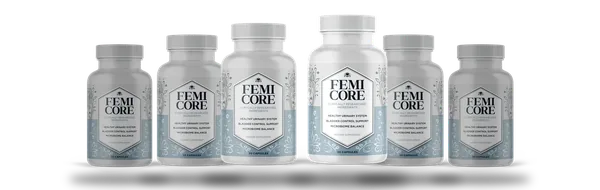
Order Femicore with the mechanism written out honestly
Three proposed routes, the research behind each ingredient, and the gap between that research and this capsule stated in the same sentence.
From $49 a bottle · 60 days to change your mind
Order Femicore On The Official WebsiteOne-time payment, no subscription · 60-day money-back guarantee · lot FEM-26/FE-3921 · tracking and refunds on +1 (302) 200-3480