Femicore Official Website › Ingredients
Femicore Ingredients: Nine Names Across Two Blends
Femicore lists nine actives across two blends, one herbal and one probiotic.
The 350 mg Herbal Blend holds mimosa pudica seed, cranberry standardised to 30% proanthocyanidin, bearberry leaf and an 8% berberine extract. The 50 mg Probiotic Blend holds five Lactobacillus strains led by crispatus LCr86.
See how these work together on how Femicore works.
Below, each name gets the research that exists, the dose that research used, and the gap between that dose and this label stated in the same paragraph.
The two numbers the Femicore panel does print
Everything else on this page is read against these two figures.
A supplement label is allowed to declare a group of ingredients as a proprietary blend, print one total for the group, and keep the split to itself. FemiCore does that twice. The Herbal Blend is 350 mg and the Probiotic Blend is 50 mg, so 400 mg of the capsule is accounted for and the rest is the gelatin shell, brown rice flour, magnesium stearate, olive oil and silicon dioxide named in the Other Ingredients line.
Two things follow, and both matter more than they sound. First, a blend total is a ceiling: nothing inside the herbal blend can be more than 350 mg, so if a trial used 500 mg of berberine on its own, this capsule cannot be matching it even if berberine were the only thing in the blend, which it is not. Second, the rules require descending order by weight, so mimosa pudica outweighs cranberry, which outweighs bearberry, which outweighs berberine. That is genuine information and it is the only distribution information you get.
The probiotic blend has a third problem the herbal one does not. Live organisms are measured in colony forming units, not milligrams, because weight tells you nothing about how many survived manufacture and storage. No colony count appears anywhere: not on the panel, not on the sales page, not in the material this desk holds.
Every Femicore ingredient, with the evidence and the dose gap
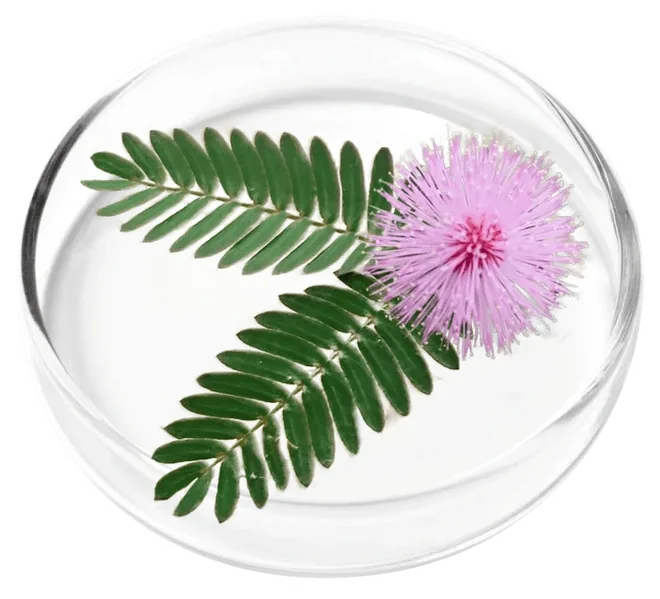
Mimosa pudica Seed Extract
Herbal Blend · Mimosa pudicaMimosa pudica seed is the first name in the herbal blend, which under the labelling rules means it outweighs the other three. It is also the thinnest item on the panel by published human evidence. The plant has a long traditional record in South Asian medicine and a modern laboratory literature about its seed mucilage, and it has no randomised human trial in urinary health that this desk can point to. That is not a reason to avoid it. It is a reason not to let it carry any weight in a buying decision.
Research dose versus this label. No established human dose for urinary support. Amount here: not published.
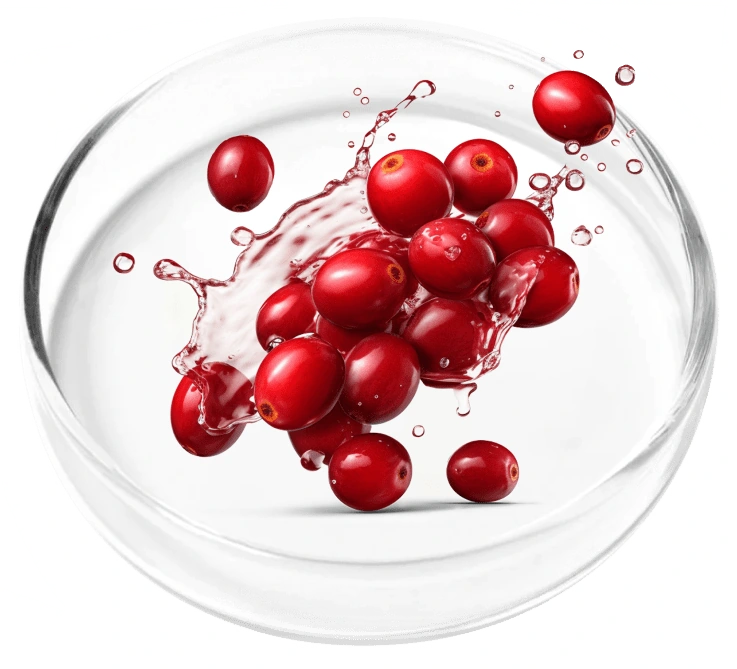
Cranberry Extract
Herbal Blend · Vaccinium macrocarpon (berry), standardised to 30% proanthocyanidinThis is the strongest item on the label and the only one carrying a standardisation figure: standardised to 30% proanthocyanidin. Proanthocyanidins are the compounds thought to interfere with bacterial adhesion in the urinary tract, and they are what the research measures. The 2023 Cochrane review of cranberry for prevention found that cranberry products reduced the risk of repeat symptomatic infection in women with recurrent infection, in children, and in people undergoing an intervention on the bladder, while finding no benefit in several other groups including older adults in care. The companion 2023 Cochrane review of cranberry as a treatment reached a blunter conclusion: as a treatment for an infection already present, the evidence does not support it.
Research dose versus this label. Trials commonly use around 36 mg of proanthocyanidin a day, and a 2021 randomised trial compared 2 mg against 37 mg. Amount here: not published.
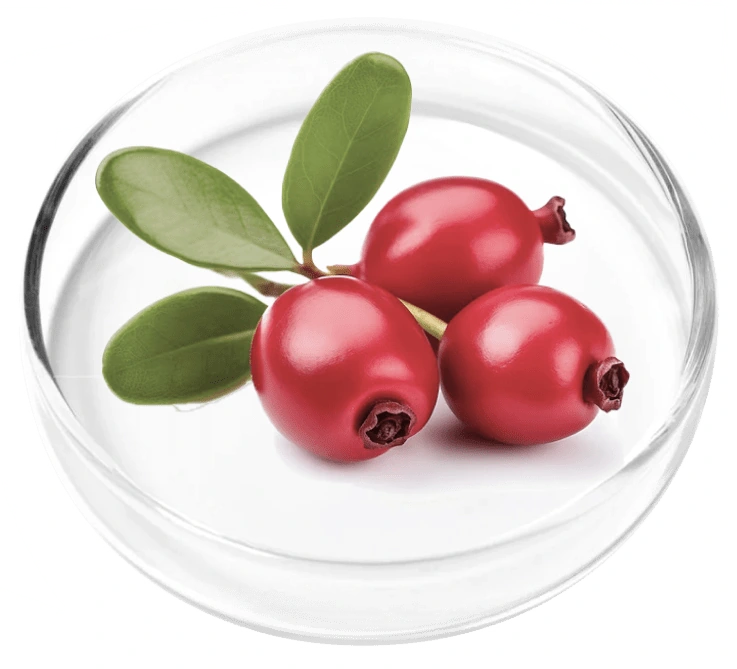
Bearberry
Herbal Blend · Arctostaphylos uva-ursi (leaf)Bearberry leaf, sold as uva-ursi, is the classic European urinary herb. Its active is arbutin, which the body converts and excretes in the urine, where hydroquinone conjugates have a traditional antiseptic reputation. It has been tested properly and recently: a 2021 randomised trial against fosfomycin gave a standardised uva-ursi extract against the antibiotic in women with uncomplicated infection, and the herb did not prove a satisfactory substitute. It also comes with the only hard duration limit on this panel, which is set out on the side effects page.
Research dose versus this label. Herbal monographs put a course at around a week at a time and no more than a handful of courses a year. Amount here: not published, and no duration is given.
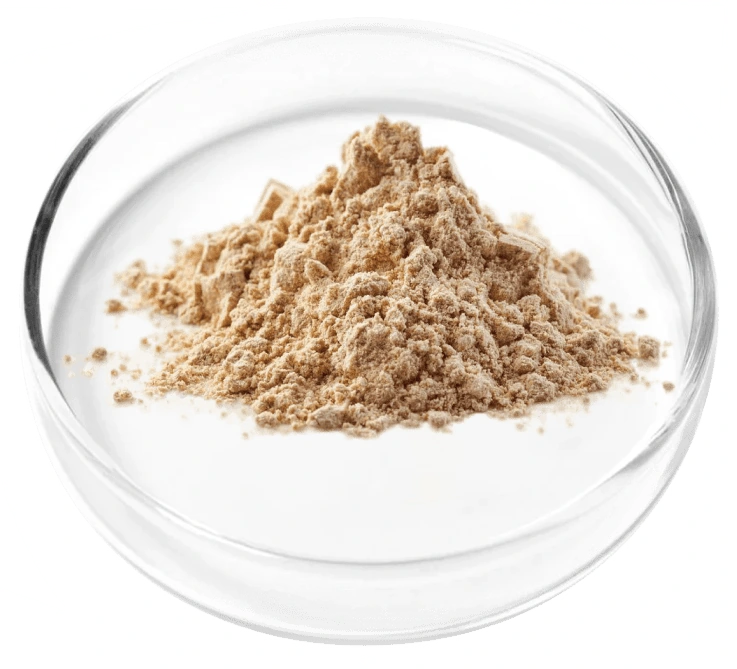
Granular Berberine Hydrochloride Extract 8%
Herbal Blend · bark/root, 8% berberineThe panel calls this a granular berberine hydrochloride extract at 8%, which is the detail to read twice. An 8% extract means berberine is eight parts in a hundred of whatever the extract weighs, so the berberine content is a fraction of an amount that is itself not published. Berberine has wide laboratory activity and a well-documented difficulty reaching the bloodstream at all, which Liu 2016 reviews in detail. An umbrella review in 2023 found the human evidence strongest in metabolic outcomes rather than urinary ones. Its real significance on this label is the interaction list.
Research dose versus this label. Metabolic trials commonly use 500 mg of berberine two or three times a day. Amount here: 8% of a figure that is not published.
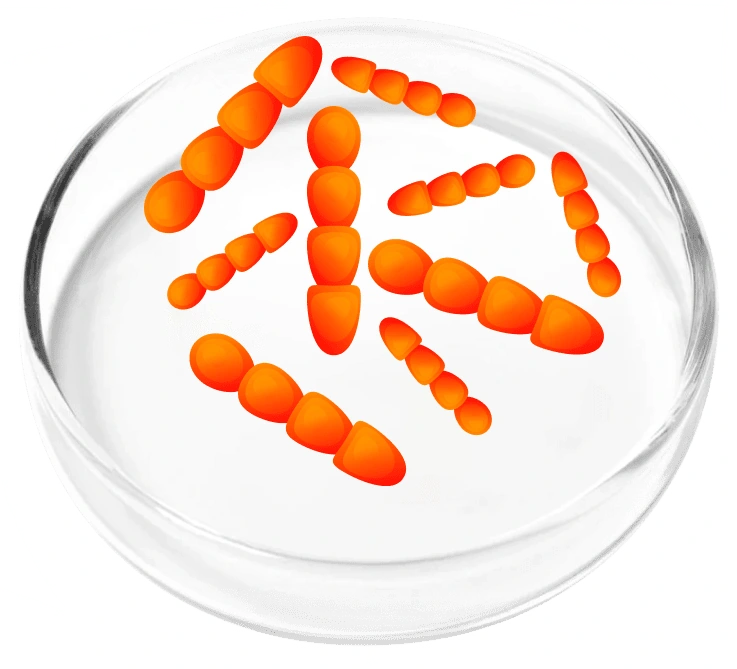
Lactobacillus crispatus LCr86
Probiotic Blend · LCr86The reason this website leads with the probiotic blend. Lactobacillus crispatus is the species that dominates a healthy vaginal microbiota in most women, and a 2020 review sets out why that matters. A strain called CTV-05 went through a phase 1 safety trial in 2007 and then a placebo-controlled phase 2 trial in 2011 in women with recurrent urinary tract infection, and a later formulation was tested against bacterial vaginosis recurrence and published in the New England Journal of Medicine. Both of those trials delivered the strain intravaginally. This is a capsule you swallow, and the results do not transfer between dose forms.
Research dose versus this label. The phase 2 trial used a suppository delivering a stated colony count. Amount here: not published, and no colony count is printed for any strain.
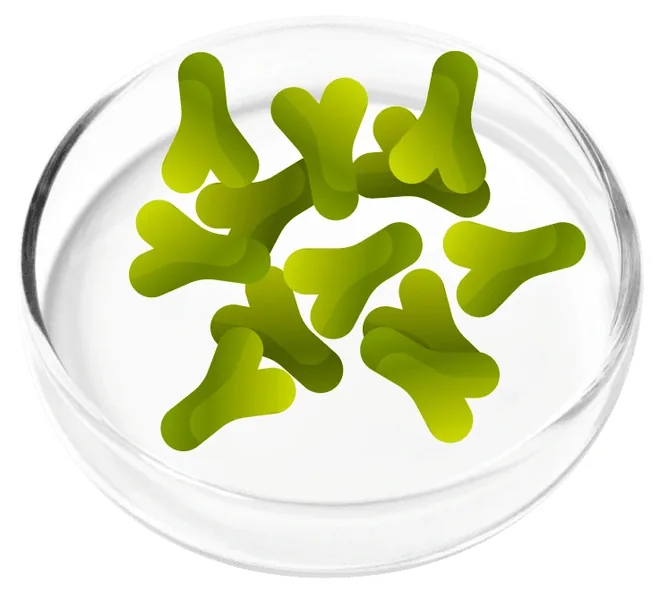
Lactobacillus acidophilus LA88
Probiotic Blend · LA88The most recognisable name in the group and, for urinary outcomes specifically, the one with the least to show. L. acidophilus is a well-studied species in digestive contexts and appears in a great many products; the LA88 designation identifies which strain was deposited, which is more than many labels give. What does not exist is a urinary trial of LA88 taken by mouth at any dose, let alone at a fraction of 50 mg.
Research dose versus this label. No established urinary dose for this strain. Amount and colony count here: not published.
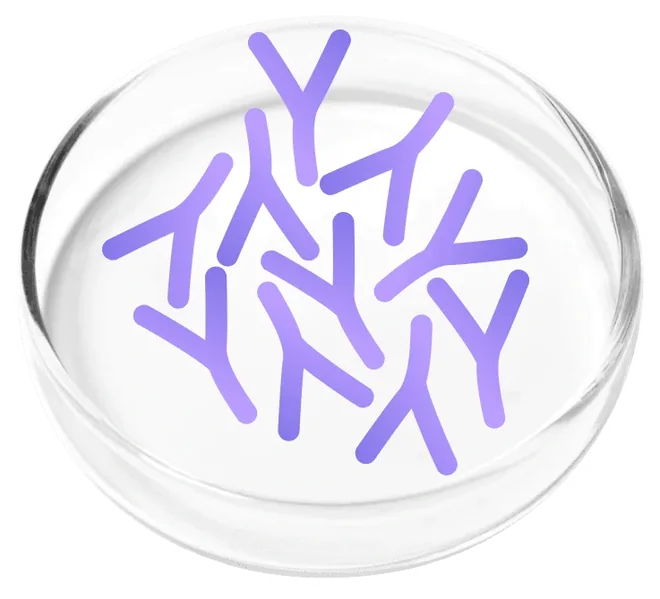
Lactobacillus plantarum N13
Probiotic Blend · N13L. plantarum N13 is one of the three names printed on the panel but missing from the retailer summary this desk was supplied with. It is a robust, widely used species that survives stomach acid comparatively well, which is a genuine argument for including it in an oral product. As with the others, the question is not whether the species is plausible but how many live organisms reach you, and that number is not on the bottle.
Research dose versus this label. No established urinary dose. Amount and colony count here: not published.
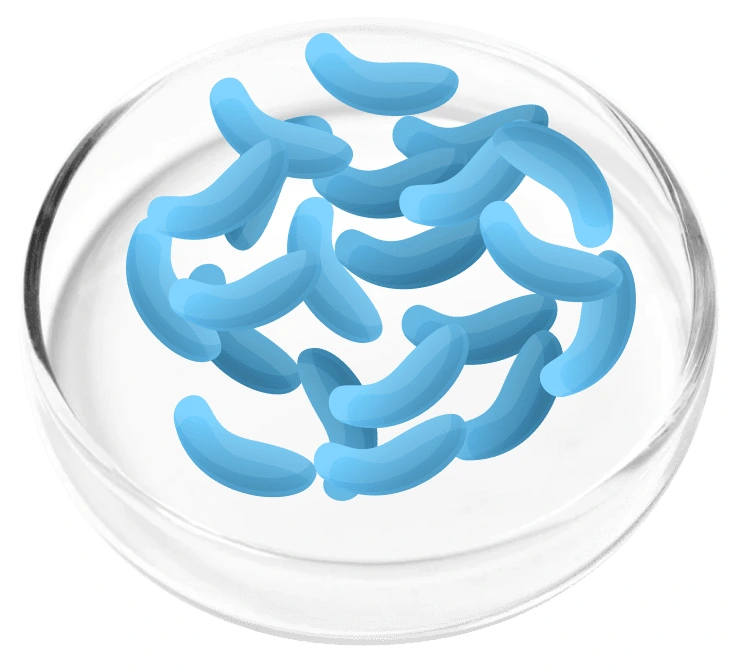
Lactobacillus gasseri LG08
Probiotic Blend · LG08L. gasseri LG08 is a vaginal-tract commensal, which makes it a reasonable companion to crispatus on a label like this one. The transfer question is the same for all five: an oral-to-vaginal colonisation trial in 2003 showed oral strains can alter vaginal flora, and a 2024 randomised trial tested an oral probiotic against vulvovaginal infection in pregnancy. Neither studied this strain at this undisclosed count.
Research dose versus this label. No established urinary dose. Amount and colony count here: not published.
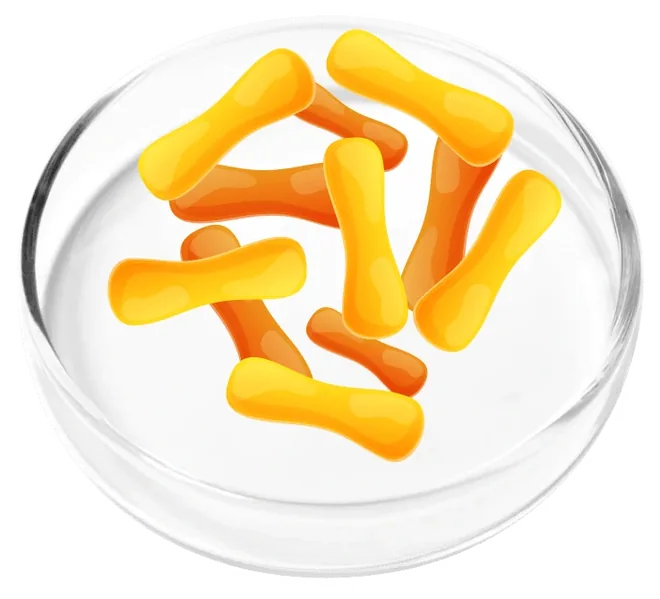
Lactobacillus casei LC16
Probiotic Blend · LC16L. casei LC16 is a dairy-fermentation workhorse with a large literature in digestive health and very little in urogenital health. It is the fifth of five strains sharing 50 mg. If the blend is divided anything like evenly, the amount of any single strain here is small; if it is not divided evenly, the labelling rules say this one is the smallest of the five, because the order is by descending weight.
Research dose versus this label. No established urinary dose. Amount and colony count here: not published.
Why some sellers list six Femicore ingredients and this page lists nine
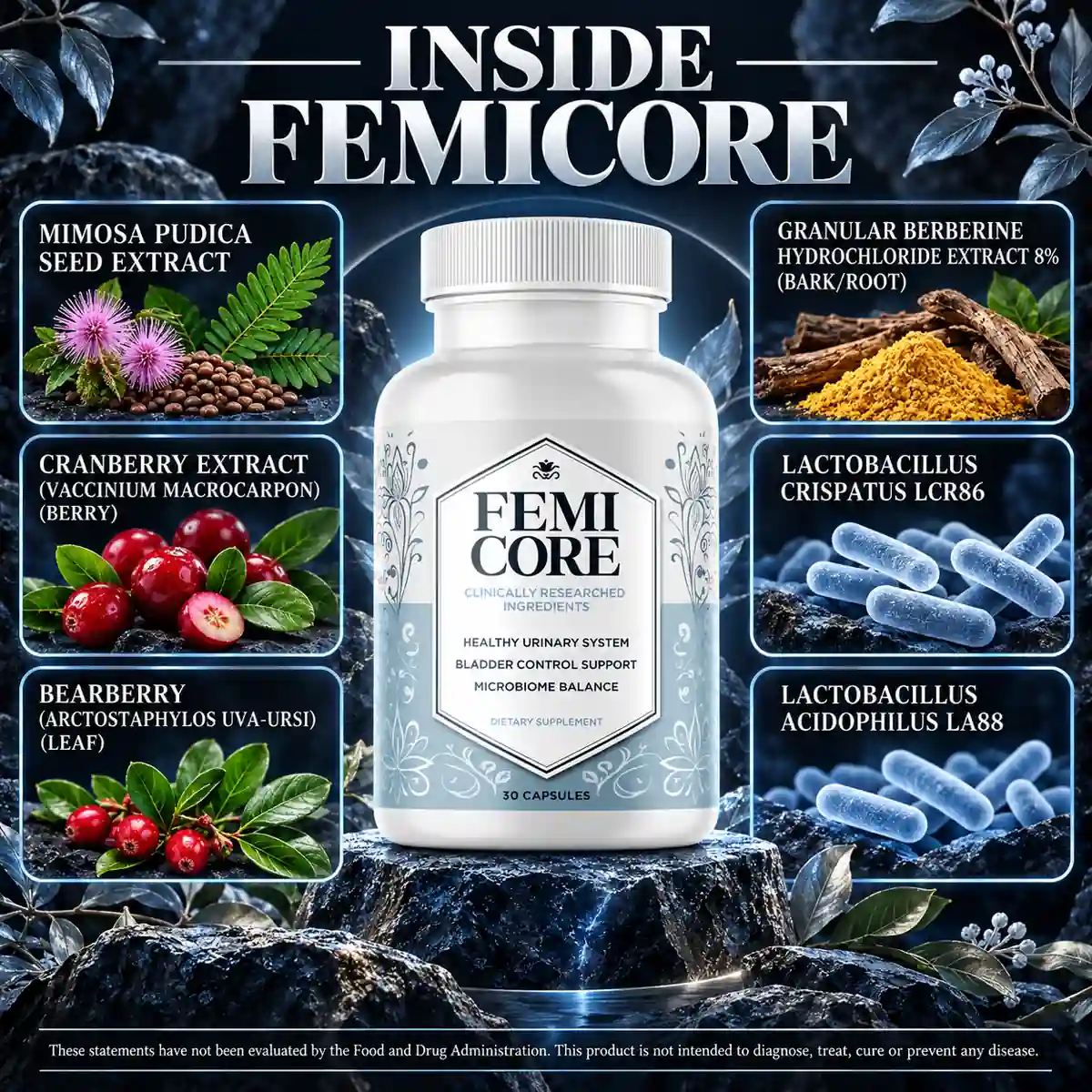
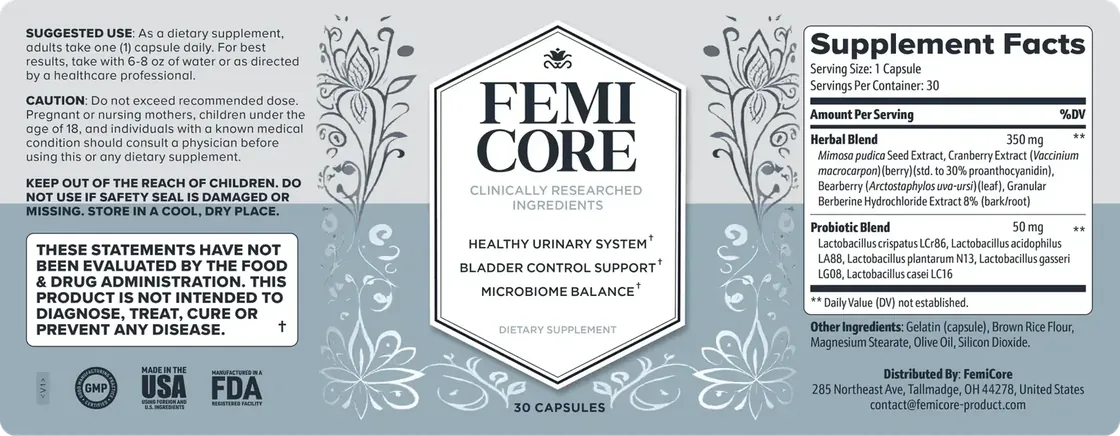
The retailer summary supplied to this desk names six: mimosa pudica, cranberry, bearberry, berberine, crispatus LCr86 and acidophilus LA88. The printed Supplement Facts panel names those six and three more: L. plantarum N13, L. gasseri LG08 and L. casei LC16.
The panel is the document with legal weight and it is photographed in this site’s own asset folder, so the panel wins and all nine appear here. If you are comparing two sellers of this bottle and the ingredient counts disagree, this is why, and neither seller is necessarily being dishonest. One is quoting a summary and the other is reading the label.
| Name | On the retailer summary | On the printed panel |
|---|---|---|
| Mimosa pudica Seed Extract | Yes | Yes |
| Cranberry Extract | Yes | Yes |
| Bearberry | Yes | Yes |
| Granular Berberine Hydrochloride Extract 8% | Yes | Yes |
| Lactobacillus crispatus LCr86 | Yes | Yes |
| Lactobacillus acidophilus LA88 | Yes | Yes |
| Lactobacillus plantarum N13 | No | Yes |
| Lactobacillus gasseri LG08 | No | Yes |
| Lactobacillus casei LC16 | No | Yes |
Femicore amounts against the amounts the research used
| Ingredient | Dose in the research | On this label | Can they be compared? |
|---|---|---|---|
| Cranberry proanthocyanidin | 2 mg to 37 mg a day in a head-to-head trial | Not published | No |
| Bearberry leaf extract | A standardised extract, short course | Not published, and no duration given | No |
| Berberine | 500 mg two or three times a day in metabolic trials | 8% of an amount that is not published | No |
| Mimosa pudica seed | No established human dose | Not published | No, and nothing to compare it to |
| L. crispatus | A stated colony count, delivered intravaginally | Not published, and this is an oral capsule | No, twice over |
| The other four strains | No urinary trials at any oral dose | Not published | No |
This table is the most useful thing on the page and it is entirely made of gaps. That is the honest position: the ingredients are real and some of the research is good, and none of it can be attached to this capsule with a number.
The Femicore Other Ingredients line, and what it gives away
Five items: gelatin (capsule), brown rice flour, magnesium stearate, olive oil and silicon dioxide. None is unusual and none is a cause for concern, but two of them tell you something.
Gelatin is animal-derived, so this capsule is not vegetarian, whatever the vegetarian-friendly mark in the marketing set implies. That contradiction is the clearest example on this product of marketing and label disagreeing, and it is checkable in ten seconds by anyone holding the bottle.
Olive oil in a capsule with a probiotic blend is a small clue about formulation: an oil suspension is one of the ways a manufacturer keeps a freeze-dried organism dry and stable inside a shell. It is a reasonable choice. It still does not tell you how many organisms went in.
- ✓Gelatin capsule, so not suitable for vegetarians or vegans
- ✓No artificial colours or sweeteners named
- ✓No caffeine, synephrine or other stimulant in either blend
- ✓No allergen statement is printed, so milk, soy and gluten status cannot be confirmed from the label alone
How this Femicore ingredient page was written
This desk publishes what the bottle says and marks the gaps. The four claims below are the ones a sceptical reader can audit in ten minutes, which is the only reason worth making them:
- The printed panel is the source. The three claim lines, the two blend totals, the nine names, the capsule count and the serving instruction are read off the FemiCore label photograph in our own asset folder, not from a review column and not from a summary.
- Not published stays not published. This panel prints 350 mg for the herbal blend and 50 mg for the probiotic blend and no amount for any of the nine names inside them. It prints no colony count for any strain. Nothing undisclosed is estimated anywhere on this website, including in the structured data a machine reads.
- Sources are real and linked in the sentence. Every study cited here was confirmed against its PubMed record through the NCBI programming interface before it was written down, and every government page was checked against its own site root first, because two of these hosts refuse a non-browser client in a way that looks exactly like a dead link.
- Corrections change the date. Write to [email protected] and the review date at the foot of the page moves forward with the fix.
We earn when you buy. Femicoredaily is the Femicore retail desk named at the top of this page, and this website makes money on orders placed through it. That is exactly why the missing-amounts table, the bearberry duration limit, the berberine interaction list and the page recommending the three-bottle pack over the six are here. They are where our interest and yours pull apart, and you should be able to watch us choose.
The desk on +1 (302) 200-3480 handles tracking, address changes and refunds, which is real service and worth having. It is not a sales line, and this website never presents it as a way to place an order. Orders go through the checkout only.

Every page, every journal post, the bottle facts and the ingredients go through review by Dr. Susan Vogler, DO, FACOG, MSCP before they ship. We write these pages from the printed FemiCore Supplement Facts panel and the manufacturer’s own sales page, cite public research for each named botanical and each named strain, and print “not published” wherever a figure is not disclosed rather than estimating it. This panel publishes two blend totals and no amount for any of the nine names inside them, and no colony count for any strain, and that fact appears on every page where an ingredient is named. Where the seller’s marketing claims more than the label supports, we say so on the page. The Physician Formulated roundel beside this paragraph names no clinician and publishes no credential, and we treat it as a manufacturer’s statement about its own process rather than as a review. Corrections are made on the page itself and the review date moves forward. Write to [email protected]. Last reviewed September 2026 by Dr. Susan Vogler, DO, FACOG, MSCP.
Sources behind the Femicore ingredient page
- Williams G, Hahn D, Stephens JH, Craig JC, Hodson EM. Cranberries for preventing urinary tract infections. Cochrane Database Syst Rev. 2023;4(4):CD001321. https://pubmed.ncbi.nlm.nih.gov/37068952/
- Jepson RG, Mihaljevic L, Craig JC. Cranberries for treating urinary tract infections. Cochrane Database Syst Rev. 2023;12(12):CD001322. https://pubmed.ncbi.nlm.nih.gov/38096261/
- Babar A, Moore L, Leblanc V, et al. High dose versus low dose standardized cranberry proanthocyanidin extract for the prevention of recurrent urinary tract infection in healthy women: a double-blind randomized controlled trial. BMC Urol. 2021;21(1):44. https://pubmed.ncbi.nlm.nih.gov/33757474/
- National Center for Complementary and Integrative Health. Cranberry. https://www.nccih.nih.gov/health/cranberry
- Gágyor I, Hummers E, Schmiemann G, et al. Herbal treatment with uva ursi extract versus fosfomycin in women with uncomplicated urinary tract infection in primary care: a randomized controlled trial. Clin Microbiol Infect. 2021;27(10):1441-1447. https://pubmed.ncbi.nlm.nih.gov/34111592/
- Schindler G, Patzak U, Brinkhaus B, et al. Urinary excretion and metabolism of arbutin after oral administration of Arctostaphylos uvae ursi extract as film-coated tablets and aqueous solution in healthy humans. J Clin Pharmacol. 2002;42(8):920-7. https://pubmed.ncbi.nlm.nih.gov/12162475/
- de Arriba SG, Naser B, Nolte KU. Risk assessment of free hydroquinone derived from Arctostaphylos uva-ursi folium herbal preparations. Int J Toxicol. 2013;32(6):442-53. https://pubmed.ncbi.nlm.nih.gov/24296864/
- Liu CS, Zheng YR, Zhang YF, Long XY. Research progress on berberine with a special focus on its oral bioavailability. Fitoterapia. 2016;109:274-82. https://pubmed.ncbi.nlm.nih.gov/26851175/
- Li Z, Wang Y, Xu Q, et al. Berberine and health outcomes: an umbrella review. Phytother Res. 2023;37(5):2051-2066. https://pubmed.ncbi.nlm.nih.gov/36999891/
- Qiu W, Jiang XH, Liu CX, Ju Y, Jin JX. Effect of berberine on the pharmacokinetics of substrates of CYP3A and P-gp. Phytother Res. 2009;23(11):1553-8. https://pubmed.ncbi.nlm.nih.gov/19370549/
- Stapleton AE, Au-Yeung M, Hooton TM, et al. Randomized, placebo-controlled phase 2 trial of a Lactobacillus crispatus probiotic given intravaginally for prevention of recurrent urinary tract infection. Clin Infect Dis. 2011;52(10):1212-7. https://pubmed.ncbi.nlm.nih.gov/21498386/
- Czaja CA, Stapleton AE, Yarova-Yarovaya Y, Stamm WE. Phase I trial of a Lactobacillus crispatus vaginal suppository for prevention of recurrent urinary tract infection in women. Infect Dis Obstet Gynecol. 2007;2007:35387. https://pubmed.ncbi.nlm.nih.gov/18288237/
- Cohen CR, Wierzbicki MR, French AL, et al. Randomized trial of Lactin-V to prevent recurrence of bacterial vaginosis. N Engl J Med. 2020;382(20):1906-1915. https://pubmed.ncbi.nlm.nih.gov/32402161/
- Chee WJY, Chew SY, Than LTL. Vaginal microbiota and the potential of Lactobacillus derivatives in maintaining vaginal health. Microb Cell Fact. 2020;19(1):203. https://pubmed.ncbi.nlm.nih.gov/33160356/
- Reid G, Charbonneau D, Erb J, et al. Oral use of Lactobacillus rhamnosus GR-1 and L. fermentum RC-14 significantly alters vaginal flora: randomized, placebo-controlled trial in 64 healthy women. FEMS Immunol Med Microbiol. 2003;35(2):131-4. https://pubmed.ncbi.nlm.nih.gov/12628548/
- Yefet E, Colodner R, Strauss M, Gam Ze Letova Y, Nachum Z. Efficacy of oral probiotic supplementation in preventing vulvovaginal infections during pregnancy: a randomized and placebo-controlled clinical trial. Nutrients. 2024;17(1):2. https://pubmed.ncbi.nlm.nih.gov/39771026/
- National Center for Complementary and Integrative Health. Probiotics: What You Need To Know. https://www.nccih.nih.gov/health/probiotics-what-you-need-to-know
Femicore ingredient questions
How many ingredients are in Femicore?
Nine named actives, in two proprietary blends. The printed Supplement Facts panel names four botanicals inside a 350 mg Herbal Blend and five Lactobacillus strains inside a 50 mg Probiotic Blend. Some seller summaries list only six of the nine.
Why does Femicore not print the amount of each ingredient?
Because both lists are declared as proprietary blends, which the labelling rules permit. A blend total is a ceiling rather than a distribution: nothing inside the 350 mg blend can exceed 350 mg, and the order of the names tells you which is largest, but not by how much.
Which Femicore ingredient has the best evidence?
Cranberry, by a distance. It is the only name on the panel with a Cochrane review behind it and the only one carrying a standardisation figure. What that review supports is fewer repeat infections in specific groups, not a general urinary tonic effect.
Does Femicore contain caffeine or a stimulant?
No. Neither blend contains caffeine, synephrine, green tea extract or any other stimulant, which can be checked against the panel rather than taken on trust.
Is the Femicore capsule shell vegetarian?
No. The Other Ingredients line names gelatin as the capsule shell. A vegetarian-friendly mark appears in the marketing set and it disagrees with the printed label.
Order Femicore with the whole panel in front of you
Nine named actives, two blend totals, and every withheld figure printed as withheld. That is the same label you will read on the bottle.
From $49 a bottle · 60 days to change your mind
Order Femicore On The Official WebsiteOne-time payment, no subscription · 60-day money-back guarantee · lot FEM-26/FE-3921 · tracking and refunds on +1 (302) 200-3480