Femicore Official Website › Blog › Femicore ingredients list
What Is In Femicore? The Full Ingredients List, Explained
Femicore lists nine named ingredients in two proprietary blends: a 350 mg Herbal Blend of four botanicals and a 50 mg Probiotic Blend of five Lactobacillus strains. Only cranberry carries a strength figure, 30% proanthocyanidin. No amount is printed for any single ingredient, and no colony count is published for any strain.
An ingredients list can look long and still tell you very little. Femicore is a good example. The names are printed clearly, but the amounts are not. That is allowed by the labelling rules, and it changes how you should read the list.
This page goes through all nine names in order, explains what the one strength figure means, and covers a few questions that come up in searches, including whether Femicore is a pill, a gummy or drops.
- Nine named ingredients: four botanicals and five Lactobacillus strains.
- Two blend totals are printed: Herbal Blend 350 mg and Probiotic Blend 50 mg.
- Cranberry is standardised to 30% proanthocyanidin. Berberine extract is 8%.
- No amount for any single ingredient and no colony count for any strain is printed.
- Other ingredients: gelatin (capsule), brown rice flour, magnesium stearate, olive oil and silicon dioxide.
- No allergen statement is printed.
What are the nine ingredients in Femicore?
The printed Supplement Facts panel names them in two groups. Within each blend, the names run in descending order by weight, and that order is the only distribution information given.
| # | Ingredient | Blend | Amount |
|---|---|---|---|
| 1 | Mimosa pudica Seed Extract | Herbal, 350 mg | Not published |
| 2 | Cranberry Extract (std. to 30% proanthocyanidin) | Herbal, 350 mg | Not published |
| 3 | Bearberry (uva-ursi leaf) | Herbal, 350 mg | Not published |
| 4 | Granular Berberine Hydrochloride Extract 8% | Herbal, 350 mg | Not published |
| 5 | Lactobacillus crispatus LCr86 | Probiotic, 50 mg | Not published; no CFU |
| 6 | Lactobacillus acidophilus LA88 | Probiotic, 50 mg | Not published; no CFU |
| 7 | Lactobacillus plantarum N13 | Probiotic, 50 mg | Not published; no CFU |
| 8 | Lactobacillus gasseri LG08 | Probiotic, 50 mg | Not published; no CFU |
| 9 | Lactobacillus casei LC16 | Probiotic, 50 mg | Not published; no CFU |
Some seller summaries list only six of the nine. The three missing from them are plantarum N13, gasseri LG08 and casei LC16. The printed panel lists all nine and is the document with legal weight.
What do the four botanicals add?
Mimosa pudica seed
First in the blend, so the largest of the four by weight. It has no modern human trial in urinary health that this site can point to.
Cranberry
The best-supported name on the label. A 2023 Cochrane review found fewer repeat infections in women with recurrent infection, and no benefit in several other groups.
Bearberry leaf
Also called uva-ursi. Traditionally used for short courses only. The label prints no duration limit.
Berberine extract 8%
An extract at 8% of an amount that is itself not published. It inhibits CYP3A4 and P-glycoprotein and lowers blood glucose.
What is PAC in cranberry, and does Femicore print it?
PAC stands for proanthocyanidin. These are the compounds in cranberry that are thought to interfere with bacteria sticking to the lining of the urinary tract. They are what the research measures, so a label that gives a PAC percentage is more useful than one that gives only a weight of dried berry.
Femicore prints one strength figure: cranberry standardised to 30% proanthocyanidin. But it does not print how much cranberry extract is in the capsule. So the milligrams of PAC cannot be worked out. For comparison, trials commonly use around 36 mg of PAC a day, and one 2021 trial compared 2 mg with 37 mg. The label gives no way to place Femicore on that scale.
What do the five probiotic strains add?
Lactobacillus crispatus LCr86 is first, so it is the largest of the five by weight. Crispatus is a species that dominates a healthy vaginal microbiota in most women. The well-known crispatus trials delivered their strain intravaginally, not by capsule, and they are not trials of this strain at this count.
The other four strains, acidophilus LA88, plantarum N13, gasseri LG08 and casei LC16, have no urinary trial of that exact strain that this site can point to. Live organisms are dosed in colony forming units, not milligrams, and no CFU figure is printed for any of them. That is the most important omission on the label.
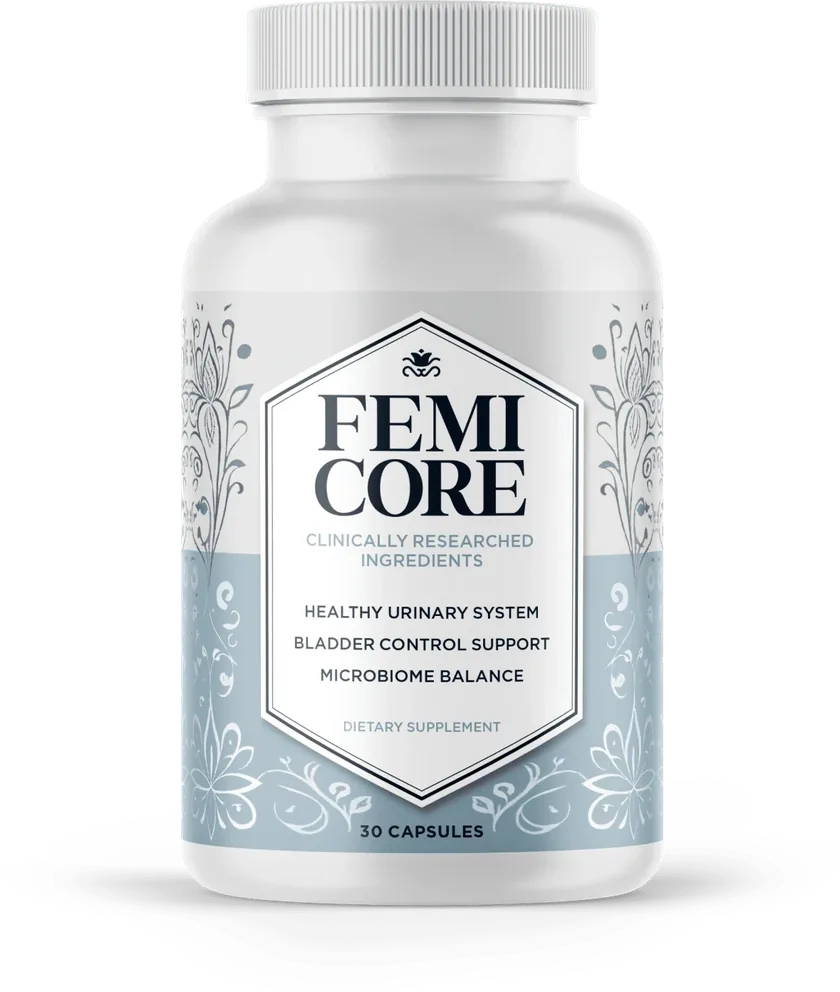
Read the whole label before you buy. The checkout shows today’s price and the 60-day guarantee for a capsule whose gaps are listed openly.
See today’s price and guaranteeDisclosure: this website earns money on orders placed through its checkout. Femicore is a dietary supplement and is not FDA approved.
What else is in the capsule?
The Other Ingredients line reads: gelatin (capsule), brown rice flour, magnesium stearate, olive oil and silicon dioxide. Gelatin is animal-derived, so the capsule is not vegetarian, even though a vegetarian-friendly mark appears in the marketing set. The label is the document that counts.
- Together the two blends account for 400 mg of named material. The rest of the capsule is the shell and these other ingredients.
- No allergen statement is printed. The gluten-free and dairy-free marks cannot be checked against the bottle.
- No stimulant is named in either blend, and that can be checked against the panel.
Is Femicore a capsule, a pill, a gummy or drops?
It is a capsule. It is not a gummy, a chewable, a powder or drops. People also call it a pill in searches, which is fine in everyday speech, but the product itself is a gelatin capsule. The serving is one capsule a day and a bottle holds 30.
What is not published about the Femicore formula?
- The amount of each of the nine ingredients.
- The colony forming units, for the blend and for each strain.
- The split of the 50 mg between the five strains.
- An allergen statement.
- A duration limit for bearberry.
- A laboratory report. The retailer holds a certificate reference, FEM-3921-26-FE, and has not read the report behind it.
The finished capsule has also never been tested in a clinical trial. Every study cited on this site concerns one ingredient or one strain.
Where do these facts come from?
- Femicore ingredients page on this site: all nine names with the evidence for each.
- Femicore label page on this site: the printed Supplement Facts panel.
- Williams 2023, Cochrane review of cranberry for prevention: pubmed.ncbi.nlm.nih.gov/37068952
- Babar 2021, BMC Urol, high-dose and low-dose cranberry PAC: pubmed.ncbi.nlm.nih.gov/33757474
Frequently asked questions
What are the ingredients in Femicore?
Nine named ingredients: mimosa pudica seed extract, cranberry extract, bearberry, berberine extract 8%, and five Lactobacillus strains, crispatus LCr86, acidophilus LA88, plantarum N13, gasseri LG08 and casei LC16.
How much of each ingredient is in a Femicore capsule?
Not published. Only two blend totals are printed: 350 mg for the Herbal Blend and 50 mg for the Probiotic Blend.
What does 30% PAC mean on the Femicore label?
The cranberry extract is standardised to 30% proanthocyanidin. The amount of cranberry extract is not published, so the milligrams of PAC cannot be calculated.
Is Femicore vegetarian?
No. The capsule shell is gelatin, which is animal-derived, even though a vegetarian-friendly mark appears in the marketing set.
Is Femicore a gummy or drops?
No. It is a capsule, one a day, with 30 capsules in a bottle.
Does Femicore contain a stimulant?
No stimulant is named in either blend, and that can be checked against the printed panel.
Our view
Our view is that the list is real and the detail is thin. The names are clear, the strength figure for cranberry is useful, and the order of the names gives a hint about weight. Everything that would let you compare the capsule with a trial is missing.
If that is acceptable to you, the guarantee gives you a way to test it yourself. If you are on prescription medicine, or pregnant or nursing, or have a known condition, speak to a doctor or pharmacist first. This page is not medical advice.
If the gaps are acceptable to you, you can order with the guarantee in view. If you take prescription medicine, ask a pharmacist about berberine first.
See today’s price and guaranteeDisclosure: this website earns money on orders placed through its checkout. Femicore is a dietary supplement and is not FDA approved.