Femicore Official Website › Blog › L. crispatus LCr86
What L. Crispatus LCr86 Does, And How It Was Tested
- Lactobacillus crispatus is the species that dominates a healthy vaginal microbiota in most women, and that is a real finding rather than a marketing line.
- Two genuine trials sit behind it: a phase 2 randomised trial in recurrent urinary tract infection and a New England Journal of Medicine trial in bacterial vaginosis.
- Both delivered the organism intravaginally, as a suppository or applicator. A swallowed capsule is a different intervention.
- Oral transfer to the vaginal tract has been shown for other strains at stated doses. It has not been shown for LCr86.
- No colony forming unit count is published for this strain in Femicore, which makes the question unanswerable from the label in either direction.
What Lactobacillus crispatus actually is
Lactobacillus crispatus is a lactic acid bacterium and a normal inhabitant of the human vaginal tract. It is not an exotic ingredient and it was not invented for a supplement label. It is one of a handful of species that turn up when researchers sequence what is living in a healthy vagina, and in most women it is the one that turns up most.
The strain designation matters more than the species name. LCr86 is a specific deposited organism, in the same way that a particular apple cultivar is a specific tree rather than the idea of an apple. Two strains of the same species can behave differently: they produce different amounts of lactic acid, adhere differently, and survive storage differently. That is why NCCIH says plainly that probiotic effects are strain-specific, and why a label naming a strain is telling you something a label saying “probiotic blend” is not.
FemiCore names five strains, and crispatus LCr86 is first on the list. Under the labelling rules that means it is the largest of the five by weight inside a 50 mg blend. That is the whole of what the panel discloses about it.
Why one species dominates a healthy vaginal microbiota
A 2020 review in Microbial Cell Factories sets out the mechanism. Lactobacilli metabolise glycogen from the vaginal epithelium and produce lactic acid, which holds the pH low. A low pH is inhospitable to a range of organisms that cause trouble when they get established, and some strains also produce hydrogen peroxide and bacteriocins that work against the same organisms directly.
Researchers group the resulting communities into a small number of types. The ones dominated by L. crispatus are consistently associated with the most stable picture, and communities with a low proportion of lactobacilli are associated with more problems. That association is well established and it is the honest basis for every product in this category.

What association does not establish is direction. A community dominated by crispatus might be stable because crispatus is there, or crispatus might flourish because the community is stable for some other reason. Untangling that requires putting the organism in and seeing what happens, which is exactly what the trials below did.
The two trials people cite, and what they did
There are two, and they are genuinely good studies rather than the marketing-grade evidence this category usually offers.
The first began with a phase 1 safety trial published in 2007, which established that a vaginal suppository containing L. crispatus CTV-05 was tolerated. That led to a randomised, placebo-controlled phase 2 trial published in Clinical Infectious Diseases in 2011, in women with recurrent urinary tract infection. It is the study every page in this category points at.
The second is larger and more recent. A reformulated version of the same organism, called LACTIN-V, was tested against recurrence of bacterial vaginosis after standard treatment and published in the New England Journal of Medicine in 2020. Publication in that journal is not a small thing; it means the trial design and the analysis survived serious review.
| Stapleton 2011 | Cohen 2020 | |
|---|---|---|
| Condition | Recurrent urinary tract infection | Recurrent bacterial vaginosis |
| Design | Randomised, placebo-controlled, phase 2 | Randomised, placebo-controlled |
| Organism | L. crispatus CTV-05 | L. crispatus CTV-05, as LACTIN-V |
| Route | Intravaginal suppository | Intravaginal applicator |
| Dose | A stated colony count per application | A stated colony count per application |
| Published in | Clinical Infectious Diseases | New England Journal of Medicine |
The row in bold is the one that decides whether any of this transfers to a swallowed capsule, and it is the row a sales page will not show you.
The problem: suppository against swallowed capsule
Both trials put the organism where it was meant to live. Neither asked anyone to swallow anything.
That is not a technicality. A suppository delivers a known quantity of live organisms directly to the surface they are intended to colonise. A capsule asks the same organisms to survive stomach acid, pass through a gut already containing something in the order of a hundred trillion bacteria of its own, and then reach an entirely different part of the body in sufficient numbers to matter.
Each of those steps loses organisms. None of them is impossible, and the loss at each is not something a label can assert without measuring it.
So when a capsule label names L. crispatus, two things are true at once. The species genuinely has trial evidence behind it, which is more than almost anything else in this aisle can say. And that evidence was generated by a route this product does not use.
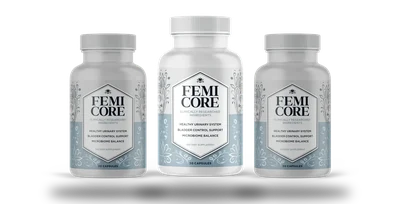
The Femicore panel, published in full
Nine named actives, two blend totals, and every figure the label withholds printed as withheld. Including this one.
From $49 a bottle · 60-day guarantee
Order FemicoreCan a swallowed probiotic reach the urogenital tract?
Sometimes, and it has been demonstrated. The best-known work is a randomised, placebo-controlled trial published in 2003 in sixty-four healthy women, which took two strains by mouth and measured a change in vaginal flora. The strains were L. rhamnosus GR-1 and L. fermentum RC-14, at a stated daily dose, over weeks rather than days.
More recent work has continued in the same direction. A randomised, placebo-controlled trial published in 2024 tested an oral probiotic against vulvovaginal infection during pregnancy. Again: named strains, a stated dose, a defined population.
Two things follow. Oral administration is a plausible route rather than a fantasy, which is a real point in favour of products like this one. And every demonstration of it has been strain-specific and dose-specific, which means it cannot be assumed for a different strain at an unpublished count.
- Demonstrated: two particular strains, swallowed daily, changed vaginal flora in healthy women.
- Not demonstrated: that LCr86 does the same thing.
- Not demonstrable from this label: whether enough organisms are present for the question to even arise.
The number that would settle it, and is not printed
Live organisms are counted in colony forming units, the number of viable cells capable of multiplying. That is the unit every trial in this field uses and the unit any serious probiotic label prints.
FemiCore prints a Probiotic Blend of 50 mg and no colony count at all, for the blend or for any of the five strains. Milligrams describe the weight of the powder. Freeze-dried bacterial powder varies enormously in how many viable organisms it holds per milligram, depending on the strain, the drying process, the carrier and how long the bottle has sat somewhere warm.
So 50 mg is compatible with a count that would be taken seriously in a trial, and it is equally compatible with a token quantity. Nothing on the bottle distinguishes those, and this website will not guess. The full list of what the panel does and does not print is on the label page.
| Question | Answered on the label? | Why it matters |
|---|---|---|
| Which strain? | Yes — LCr86 | Research is strain-specific, so this is a genuine disclosure |
| How many colony forming units? | No | It is the unit the entire field uses |
| Measured when: at manufacture or at expiry? | No | Counts fall over shelf life, sometimes steeply |
| How is the blend split between five strains? | No | Only the descending order is knowable |
| Any evidence for this strain taken orally? | None published | The trials used a suppository |
Three of those five are one printed line each. That is the size of the gap between this label and a label a reader could actually evaluate.
What a buyer should conclude from all this
Not that the product is a fraud, and not that the strain is a gimmick. Both of those would be lazy.
The accurate summary is narrower and more useful. L. crispatus is the most research-backed organism in this entire category, and the research was done by a route this capsule does not use, at a count this capsule does not publish. Naming the strain is to the manufacturer’s credit. Not naming the count is not.
If you buy Femicore because of the probiotic blend, you are buying a plausible idea with a well-studied organism at its head and a specific evidence gap in the middle. That is a legitimate decision for somebody who knows it, and it is the reason this website leads with the strains rather than burying them under a claim about bladder control. What the label supports, and what it does not, is set out on the benefits page.
Three questions worth asking a manufacturer
These apply to any probiotic in any aisle, and an answer to any one of them would improve this label.
- What is the colony forming unit count per capsule, and is it measured at manufacture or at the end of shelf life? The second number is the honest one and very few products print it.
- Is there any human data for this strain taken orally? If the answer is a reference to a trial using a suppository, that is worth knowing.
- How is the blend divided between the five strains? Descending order by weight is all a proprietary blend reveals, and a manufacturer can always say more than the minimum.
If this information is published, this page will carry it and the review date at the foot will move forward. Until then, the description above is the whole of what can be said honestly, and the rest of this website is written to the same standard. The other four strains get the same treatment on the ingredients page.
Sources cited in this article
- Stapleton AE, Au-Yeung M, Hooton TM, et al. Randomized, placebo-controlled phase 2 trial of a Lactobacillus crispatus probiotic given intravaginally for prevention of recurrent urinary tract infection. Clin Infect Dis. 2011;52(10):1212-7. https://pubmed.ncbi.nlm.nih.gov/21498386/
- Czaja CA, Stapleton AE, Yarova-Yarovaya Y, Stamm WE. Phase I trial of a Lactobacillus crispatus vaginal suppository for prevention of recurrent urinary tract infection in women. Infect Dis Obstet Gynecol. 2007;2007:35387. https://pubmed.ncbi.nlm.nih.gov/18288237/
- Cohen CR, Wierzbicki MR, French AL, et al. Randomized trial of Lactin-V to prevent recurrence of bacterial vaginosis. N Engl J Med. 2020;382(20):1906-1915. https://pubmed.ncbi.nlm.nih.gov/32402161/
- Chee WJY, Chew SY, Than LTL. Vaginal microbiota and the potential of Lactobacillus derivatives in maintaining vaginal health. Microb Cell Fact. 2020;19(1):203. https://pubmed.ncbi.nlm.nih.gov/33160356/
- Reid G, Charbonneau D, Erb J, et al. Oral use of Lactobacillus rhamnosus GR-1 and L. fermentum RC-14 significantly alters vaginal flora: randomized, placebo-controlled trial in 64 healthy women. FEMS Immunol Med Microbiol. 2003;35(2):131-4. https://pubmed.ncbi.nlm.nih.gov/12628548/
- Yefet E, Colodner R, Strauss M, Gam Ze Letova Y, Nachum Z. Efficacy of oral probiotic supplementation in preventing vulvovaginal infections during pregnancy: a randomized and placebo-controlled clinical trial. Nutrients. 2024;17(1):2. https://pubmed.ncbi.nlm.nih.gov/39771026/
- National Center for Complementary and Integrative Health. Probiotics: What You Need To Know. https://www.nccih.nih.gov/health/probiotics-what-you-need-to-know

Every page, every journal post, the bottle facts and the ingredients go through review by Dr. Susan Vogler, DO, FACOG, MSCP before they ship. We write these pages from the printed FemiCore Supplement Facts panel and the manufacturer’s own sales page, cite public research for each named botanical and each named strain, and print “not published” wherever a figure is not disclosed rather than estimating it. This panel publishes two blend totals and no amount for any of the nine names inside them, and no colony count for any strain, and that fact appears on every page where an ingredient is named. Where the seller’s marketing claims more than the label supports, we say so on the page. The Physician Formulated roundel beside this paragraph names no clinician and publishes no credential, and we treat it as a manufacturer’s statement about its own process rather than as a review. Corrections are made on the page itself and the review date moves forward. Write to [email protected]. Last reviewed September 2026 by Dr. Susan Vogler, DO, FACOG, MSCP.