Femicore Official Website › Blog › Berberine interactions
Berberine And Your Prescriptions: What To Check
- Berberine inhibits CYP3A4 and P-glycoprotein, which between them handle a large share of prescription medicines.
- Inhibiting either can raise blood levels of an affected drug, which is a pharmacokinetic fact rather than a theoretical worry.
- It also lowers blood glucose, so it may add to the effect of diabetes medication.
- Berberine is poorly absorbed, which is well documented, and that does not remove the interaction question because the gut is where much of CYP3A4 activity sits.
- FemiCore prints an 8% berberine extract inside a 350 mg blend, so the amount is two unknowns multiplied together.
What berberine is and why it is on this label
Berberine is a yellow alkaloid found in several plants, including goldenseal, Oregon grape and barberry. It has been used in traditional Chinese and Ayurvedic medicine for a long time, and it has attracted serious modern research interest, mostly in metabolic health rather than in urinary health.
On a urinary label it is there for its broad antimicrobial activity in the laboratory. FemiCore prints it as “Granular Berberine Hydrochloride Extract 8% (bark/root)”, last of four in a 350 mg Herbal Blend.
An umbrella review published in 2023 looked across the evidence and found the human data strongest in metabolic outcomes. Its practical significance on a label like this one is not the benefit. It is the interaction list.
CYP3A4 and P-glycoprotein, in plain terms
Two systems decide how much of a swallowed drug reaches your bloodstream and how long it stays there.
CYP3A4 is an enzyme, found in the liver and abundantly in the wall of the small intestine, that chemically modifies a very large share of prescription medicines so they can be cleared. Estimates commonly put it at a substantial fraction of all drugs in clinical use.
P-glycoprotein is a transporter that sits in cell membranes and actively pumps certain substances back out of cells, including back into the gut. It reduces how much of a drug is absorbed in the first place.
Inhibit either and the affected drug is cleared more slowly or absorbed more completely. Blood levels rise. For a medicine with a wide safety margin that may not matter. For one with a narrow one it can matter a great deal, and the same principle is why grapefruit juice carries a warning on some prescriptions.
What the interaction evidence actually shows
The direct work is a study published in Phytotherapy Research in 2009 on the effect of berberine on the pharmacokinetics of CYP3A and P-glycoprotein substrates. It is the reference behind every caution on this subject, and it is why this is treated on this website as an established interaction rather than a possibility.
Two qualifications belong in the same paragraph, because overstating this is as unhelpful as ignoring it.
- The size of the effect depends on the dose. Studies of berberine interactions use stated amounts, usually far larger than a fraction of an 8% extract inside a blend.
- It depends on the drug. A medicine with a wide therapeutic window tolerates a modest change in blood level; one with a narrow window may not.
Neither qualification is a reason to skip the question. Both are reasons why the question belongs to somebody who can see your actual prescription list rather than to a web page.
| If you take | Why | What to do |
|---|---|---|
| Anything cleared by CYP3A4 | A long list including many statins, some blood pressure medicines and several immunosuppressants | Ask a pharmacist with your actual list in front of them |
| Metformin or another glucose-lowering drug | Berberine lowers blood glucose, so the effects may add | Ask the prescriber and watch for lows |
| An immunosuppressant | Narrow therapeutic window and a CYP3A4 route | Ask before starting |
| An anticoagulant | Worth raising alongside the cranberry and warfarin question | Mention it at the next review |
| Nothing on prescription | The interaction has nothing to act on | No action needed |
The last row is the one most readers are in, and it is why this article ends with a section on proportion rather than on alarm.
The blood sugar effect, which is separate
Berberine’s best-supported human effect is on glucose metabolism. The umbrella review found the strongest human evidence in metabolic outcomes, and that is a real effect rather than a theoretical one.
For somebody not taking glucose-lowering medication this is simply a property of the compound. For somebody who is, it is an additive effect worth knowing about, because two things lowering blood sugar at once can lower it further than either alone.
That belongs to the prescriber rather than to this page. It is on the list above because a urinary supplement is the last place most people would look for a glucose effect, which is exactly why it is worth flagging.
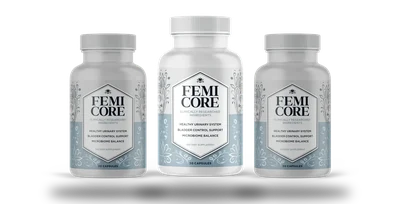
The whole Femicore panel, including the awkward parts
Two blend totals, nine names, the berberine interaction list and the bearberry duration limit, all published rather than tucked away.
From $49 a bottle · 60-day guarantee
Order FemicorePoorly absorbed, and why that does not settle it
Berberine is famously difficult to get into the bloodstream. A 2016 review in Fitoterapia covers the research effort devoted to improving its oral bioavailability, which is a substantial field in itself.
It is tempting to conclude that poor absorption removes the interaction question. It does not, and the reason is anatomical.
A large share of CYP3A4 activity sits in the wall of the small intestine, and P-glycoprotein sits in the membranes of the same cells. Both do their work on a drug as it is being absorbed. A compound that stays in the gut is in exactly the right place to interact with them, whether or not it goes anywhere afterwards.
So poor absorption reduces the systemic effects of berberine itself while leaving the gut-level interaction intact. That is a genuinely counter-intuitive point and it is the reason this article does not treat low bioavailability as reassurance.
How much berberine is in Femicore?
Two unknowns multiplied together, and it is worth working through slowly.
The panel prints “Granular Berberine Hydrochloride Extract 8%”. The 8% is the concentration of berberine in the extract, so 100 mg of that extract contains 8 mg of berberine.
How much of the extract is in a capsule is not published. It sits inside a 350 mg Herbal Blend, last of four names, which under the labelling rules means it weighs less than the bearberry, which weighs less than the cranberry, which weighs less than the mimosa pudica. That is the whole of the disclosure.
So the berberine content is 8% of an undisclosed fraction of 350 mg. It is certainly a small number and it cannot be stated. Metabolic trials commonly use 500 mg of berberine two or three times a day, which is an entirely different order of magnitude, and that comparison is in the dose table on the ingredients page.
Does a small amount still interact? Probably less. Possibly not at all. Nobody can tell you where on that scale this capsule sits, and that uncertainty is a reason to ask rather than a reason to assume.
The five-minute pharmacist conversation
This is the practical output of the whole article, and it is genuinely short.
- Take your prescription list, or the boxes.
- Say: “I am thinking of taking a supplement containing berberine. Does anything I take go through CYP3A4 or P-glycoprotein?”
- Add: “It also contains bearberry, which I understand is usually a short course. Does that change anything for me?”
- Mention that the label publishes no individual amounts, because that changes how a pharmacist weighs the answer.
A pharmacist reading this panel will spot the berberine line before you finish the first sentence. The conversation is free, it takes less time than reading this paragraph, and it is the single most useful thing anyone on prescription medication can do before starting a product like this one. The same advice appears on the side effects page and on the who it is for page, because it is worth repeating.
Keeping this in proportion
An article about interactions can leave an impression it did not intend, so here is the proportion.
If you take no prescription medicine, this entire subject has nothing to act on. The berberine in this capsule is a small amount of a compound with wide traditional use and a modern research record, and the rest of this website treats it accordingly.
If you do take something on prescription, this is one conversation rather than a prohibition. Plenty of people take berberine alongside medication with a clinician’s knowledge, and the point is the knowledge rather than the abstention.
What would be wrong is silence. A retail page that lists nine ingredients and never mentions that one of them affects how medicines are cleared is not being reassuring; it is leaving a reader to discover the question somewhere else, or not at all. That is the reason this article exists on the website of the desk that sells the product, and the same reasoning is set out on the about page.
Sources cited in this article
- Qiu W, Jiang XH, Liu CX, Ju Y, Jin JX. Effect of berberine on the pharmacokinetics of substrates of CYP3A and P-gp. Phytother Res. 2009;23(11):1553-8. https://pubmed.ncbi.nlm.nih.gov/19370549/
- Li Z, Wang Y, Xu Q, et al. Berberine and health outcomes: an umbrella review. Phytother Res. 2023;37(5):2051-2066. https://pubmed.ncbi.nlm.nih.gov/36999891/
- Liu CS, Zheng YR, Zhang YF, Long XY. Research progress on berberine with a special focus on its oral bioavailability. Fitoterapia. 2016;109:274-82. https://pubmed.ncbi.nlm.nih.gov/26851175/
- National Center for Complementary and Integrative Health. Probiotics: What You Need To Know. https://www.nccih.nih.gov/health/probiotics-what-you-need-to-know

Every page, every journal post, the bottle facts and the ingredients go through review by Dr. Susan Vogler, DO, FACOG, MSCP before they ship. We write these pages from the printed FemiCore Supplement Facts panel and the manufacturer’s own sales page, cite public research for each named botanical and each named strain, and print “not published” wherever a figure is not disclosed rather than estimating it. This panel publishes two blend totals and no amount for any of the nine names inside them, and no colony count for any strain, and that fact appears on every page where an ingredient is named. Where the seller’s marketing claims more than the label supports, we say so on the page. The Physician Formulated roundel beside this paragraph names no clinician and publishes no credential, and we treat it as a manufacturer’s statement about its own process rather than as a review. Corrections are made on the page itself and the review date moves forward. Write to [email protected]. Last reviewed September 2026 by Dr. Susan Vogler, DO, FACOG, MSCP.