Femicore Official Website › Blog › Bearberry duration
Bearberry: Why Uva-Ursi Is Not A Daily Herb
- Bearberry, or uva-ursi, is a traditional urinary herb with a genuine short-course tradition: roughly a week at a time, a few times a year.
- Its active, arbutin, is converted and excreted in the urine as hydroquinone conjugates, which is both the mechanism and the reason for the limit.
- Hydroquinone exposure from uva-ursi preparations has been formally risk-assessed, and the assessment concerns cumulative exposure rather than a single dose.
- A randomised trial against an antibiotic did not find uva-ursi a satisfactory substitute in uncomplicated infection.
- FemiCore prints no duration limit and no amount of bearberry, so neither the exposure nor the limit can be worked out from the bottle.
What bearberry is and where it comes from
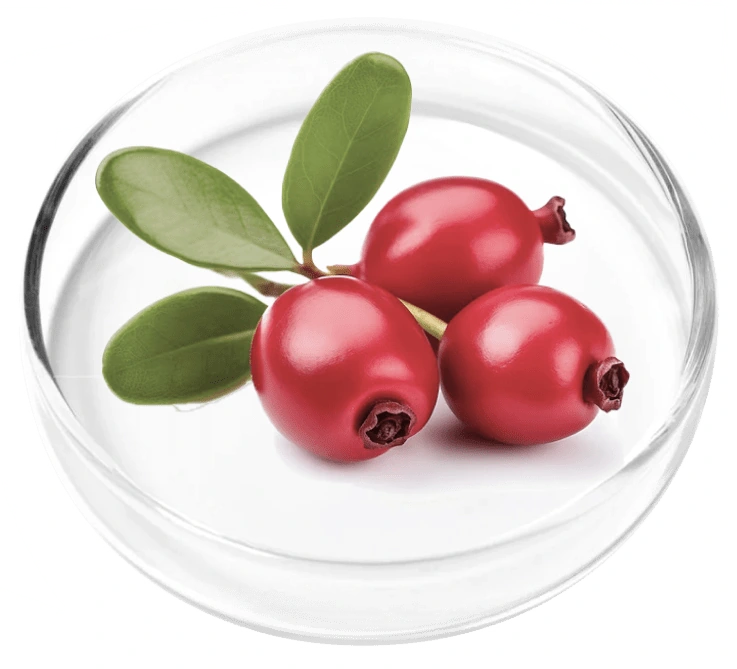
Bearberry is Arctostaphylos uva-ursi, a low evergreen shrub found across the northern hemisphere. The leaf is the part used, which is what the FemiCore panel specifies when it prints “Bearberry (Arctostaphylos uva-ursi) (leaf)”. That specificity is worth noticing: the leaf is the traditional material and a label that names the plant part is being more precise than one that does not.
It has been used for urinary complaints in European herbal practice for a very long time, long enough that its use predates any understanding of bacteria. It is one of the few herbs in this aisle with a genuinely old and genuinely specific reputation rather than a general tonic one.
How arbutin is supposed to work
The active constituent is arbutin, a glycoside. Swallowed, it is metabolised and the products are excreted in the urine, where hydroquinone conjugates end up concentrated. A 2002 pharmacokinetic study measured exactly that excretion after oral administration of a standardised extract, in both a tablet and a solution.
Hydroquinone has antibacterial activity, so the traditional reasoning is coherent: a compound with antibacterial properties, concentrated in the urine, acting where the problem is. It is a better-reasoned mechanism than most herbal claims and it is supported by an actual measurement of where the compound goes.
But the mechanism and the caution are the same fact. The reason it might work is that hydroquinone reaches the urinary tract. The reason it is limited is that hydroquinone reaches the rest of you on the way.
Where the short-course tradition comes from
Herbal guidance on uva-ursi has been unusually consistent, and unusually restrictive, for a very long time. The general shape of it is a course of about a week at a time, repeated no more than a handful of times a year.
That is not how supplements in this aisle are sold. A supplement is sold as a daily habit in packs of one, three or six months, and the whole commercial model depends on continuous use. A traditional short-course herb inside a daily capsule is a genuine tension, and it is one that almost no label in the category acknowledges.
What the risk assessment actually assessed
This is where precision matters, because it is easy to overstate in either direction.
A risk assessment of free hydroquinone derived from Arctostaphylos uva-ursi folium herbal preparations was published in the International Journal of Toxicology in 2013. It exists because the question is real enough to warrant formal work, and the subject is free hydroquinone exposure from uva-ursi preparations rather than a single dose of the herb.
Two things follow, and both are important.
- The concern is cumulative. It is about exposure over time, which is precisely why the traditional guidance limits duration rather than dose.
- It concerns preparations with known content. A risk assessment works from a stated quantity. It cannot be applied to an undisclosed amount inside a blend, in either direction.
So this page will not tell you the bearberry in Femicore is dangerous, because that would require knowing how much is in it, and nobody outside the factory does. It will also not tell you the amount is too small to matter, for exactly the same reason. Both would be inventions, and inventing a reassurance is worse than inventing a warning.
The trial against an antibiotic, and what it found
Uva-ursi has been tested properly and recently, which is more than most of this aisle can say. A randomised controlled trial published in Clinical Microbiology and Infection in 2021 compared a standardised uva-ursi extract against fosfomycin in women presenting in primary care with uncomplicated urinary tract infection.
The herb did not prove a satisfactory substitute for the antibiotic. That is a useful result in two directions at once: it is real evidence about a real extract, and the direction it points is away from using this herb in place of treatment.
It also tells you something about dose. The trial used a standardised extract at a stated amount, because that is the only way to run a trial. A blend that prints neither cannot be compared with it.
| Question | Answer | Source |
|---|---|---|
| Does arbutin reach the urinary tract? | Yes, measured | Pharmacokinetic study, 2002 |
| Can it replace an antibiotic for uncomplicated infection? | Not satisfactorily | Randomised trial against fosfomycin, 2021 |
| Is cumulative hydroquinone exposure a live question? | Yes, formally assessed | Risk assessment, 2013 |
| Is there a standard daily long-term dose? | No | Traditional guidance is a short course |
| How much is in this capsule? | Not published | Inside a 350 mg proprietary blend |
Four of those five have an answer. The fifth is the one that would let a reader apply the other four.
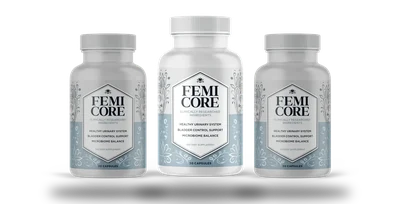
The Femicore panel, with the gaps marked
Two blend totals, nine names, and no duration limit anywhere on the bottle. All of it published rather than smoothed over.
From $49 a bottle · 60-day guarantee
Order FemicoreWhat Femicore prints, and what it leaves out
The panel prints bearberry third of four in a 350 mg Herbal Blend, which under the labelling rules means it weighs less than the mimosa pudica and the cranberry and more than the berberine extract. That is the entire distribution disclosure.
It prints no duration limit at all. The suggested use is one capsule daily, and the product is sold in packs running to six months. Nothing on the bottle suggests a break, a maximum course or a reason to ask anyone.
This desk sells that product, which is exactly why this page exists. The practical position taken across this website is on the how to take it page: plan two months, which is what the guarantee covers, and take the duration question to a pharmacist before going further. It is also one of the reasons the pricing page recommends three bottles rather than six on a first order, and the desk earns less for saying so.
What to do if you are taking it anyway
- Drink the water the label asks for. Six to eight ounces per capsule. On a bearberry product this is part of the mechanism rather than a swallowing aid.
- Decide your course length before you start. Two months is a defensible plan because it matches the guarantee window and the review record. Deciding at the end of bottle four is not a plan.
- Ask a pharmacist before going beyond that, with the panel in front of them. The berberine on the same label is the other reason to have that conversation, and it is set out on the side effects page.
- Do not take it if you have kidney or liver disease without asking first.
- Stop if symptoms appear or worsen. A supplement that is making something worse has answered the question you were asking it.
Why a proprietary blend makes the duration question worse
There is a second-order problem here that is easy to miss, and it is the reason this article exists rather than a one-line caution on a safety page.
Suppose the label printed “Bearberry leaf 40 mg”. A pharmacist could look at that, compare it against the amounts in the traditional guidance and in the risk assessment, and give you a view in about thirty seconds. The question would be answerable.
Instead the label prints a 350 mg blend containing four botanicals, with bearberry third by weight. That places it somewhere below cranberry and above the berberine extract, and nowhere more precise than that. A pharmacist asked whether the bearberry content warrants a duration limit cannot answer, because the only honest answer is that nobody outside the factory knows.
- If the amount is small, a long course is probably unremarkable, and nobody can confirm it is small.
- If the amount is meaningful, a six-month course is a question worth asking, and nobody can confirm it is meaningful.
- The proprietary blend does not resolve that in the product’s favour. It removes the ability to resolve it at all.
That is a general point about blends and this is the clearest example of it on the panel. A blend is usually discussed as a marketing problem, because it stops a buyer comparing a product against a trial. Here it is also a safety-information problem, because it stops a professional answering an ordinary question. Both are set out in the dose table on the ingredients page.
The wider problem this illustrates
Bearberry is a specific case of a general pattern worth recognising, because it will save you time on every other product in this aisle.
The supplement format wants a daily habit. Some traditional herbs were never used that way. Putting one inside a daily capsule does not change the herb, and a label that prints no duration limit has not resolved the tension so much as declined to mention it.
The test is quick. When you see a traditional herb on a daily supplement label, ask how it was traditionally used and for how long. If the traditional answer is a short course and the label says nothing, you have found a question the manufacturer has chosen not to answer. That is not always damning and it is always worth knowing, and it is one of the nine points on the checklist page.
Sources cited in this article
- Schindler G, Patzak U, Brinkhaus B, et al. Urinary excretion and metabolism of arbutin after oral administration of Arctostaphylos uvae ursi extract as film-coated tablets and aqueous solution in healthy humans. J Clin Pharmacol. 2002;42(8):920-7. https://pubmed.ncbi.nlm.nih.gov/12162475/
- de Arriba SG, Naser B, Nolte KU. Risk assessment of free hydroquinone derived from Arctostaphylos uva-ursi folium herbal preparations. Int J Toxicol. 2013;32(6):442-53. https://pubmed.ncbi.nlm.nih.gov/24296864/
- Gágyor I, Hummers E, Schmiemann G, et al. Herbal treatment with uva ursi extract versus fosfomycin in women with uncomplicated urinary tract infection in primary care: a randomized controlled trial. Clin Microbiol Infect. 2021;27(10):1441-1447. https://pubmed.ncbi.nlm.nih.gov/34111592/
- National Center for Complementary and Integrative Health. Probiotics: What You Need To Know. https://www.nccih.nih.gov/health/probiotics-what-you-need-to-know

Every page, every journal post, the bottle facts and the ingredients go through review by Dr. Susan Vogler, DO, FACOG, MSCP before they ship. We write these pages from the printed FemiCore Supplement Facts panel and the manufacturer’s own sales page, cite public research for each named botanical and each named strain, and print “not published” wherever a figure is not disclosed rather than estimating it. This panel publishes two blend totals and no amount for any of the nine names inside them, and no colony count for any strain, and that fact appears on every page where an ingredient is named. Where the seller’s marketing claims more than the label supports, we say so on the page. The Physician Formulated roundel beside this paragraph names no clinician and publishes no credential, and we treat it as a manufacturer’s statement about its own process rather than as a review. Corrections are made on the page itself and the review date moves forward. Write to [email protected]. Last reviewed September 2026 by Dr. Susan Vogler, DO, FACOG, MSCP.